Search This Blog

Monday, June 7, 2021

Mashiach: The Great Reframer

The paint has dried on the canvas of life. What has happened has happened - there is no way to change the past, to whitewash the pain, to ignore the blemishes. But, amazingly, a new frame can be placed around this canvas that suddenly shifts the entire picture.

“To reframe, then, means to change the conceptual and/or emotional setting or viewpoint in relation to which a situation is experienced and to place it in another frame which fits the ”facts” of the same concrete situation equally well or even better, and thereby changes its entire meaning.”1

“[R]eframing can be seen as a generic process in therapy. In fact, I would go much further and propose it to be the single most basic and necessary operation in the process of change and therefore of all therapy. Everything else is subordinate and either aids or, alternatively, impedes this process...It is not that ”...a new frame may be an essential setting...for change”; I would argue that it is the only setting for change...”2

We look at the painful history of our people - and the pain of the present - and we ache for comfort, Nechama. Not the comfort of soothing but the comfort of seeing; the essence of Nechama is seeing things in a new light.

“For N.Ch.M. is consolation and regret, both a complete change of feelings to the way one had felt towards something hitherto. Up till now one had considered something to be right, had perhaps boasted upon it, and then suddenly finds out that one has to be ashamed of it: regret, remorse. Similarly, real consolation is only such, that brings the conviction to one who has suffered pain and grief, that this too leads to ultimate good and everlasting happiness, not the ‘Babylonian idea of consolation’ which says, ‘what can one do, one must accept what cannot be avoided (Bava Kama 38a), but which awakes the consciousness that if one were able to see through and over all the conditions and results and consequences as God can and does, one would not alter what has happened even if one could.”3

And that is why one of Mashiach’s names is “Menachem” - The Reframer.4

We await the day when Mashiach will come and “transform darkness to light and sweeten the bitter.”5

“The World to Come is not like this world. In this world on good tidings we say the blessing of “Hatov v’Hameitiv” and in bad tidings “Dayan Ha’Emet.” In the World to Come it will always be “Hatov v’Hameitiv.”6

“Then,” in that sudden shift, “our mouths will be filled with laughter.”7

”[Humor as] a flash of insight shows a familiar situation or event in a new light, and elicits a new response to it.”8

——————————

1 Watzlawick et al., 1974, p. 95 quoted in Antti Mattila, “Seeing Things in a New Light: Reframing in Therapeutic Conversation, p. 6

2 Cade, 1992, p. 163, quoted in Antti Mattila, “Seeing Things in a New Light: Reframing in Therapeutic Conversation, p. 55-56

3 Rav Samson Raphael Hirsch on Berrishit 50:21. See also Rav Samson Raphael Hirsch on Bereishit 5:29 and Rashi on Bereishit 27:42.

 4 Sanhedrin 98b. See also Talmud Yerushalmi, Sanhedrin 10:9 and Zohar III:173b

5 See Zohar I:4a. See Rav Kook, Igrot Ha’Rayah I:142.

6 Pesachim 50a

7 Tehillim 126

8 The Act of Creation Arthur Koestler (1964), quoted in Antti Mattila, “Seeing Things in a New Light: Reframing in Therapeutic Conversation, p. 93


Tuesday, December 22, 2020

The Study of Torah in Dark Times - VII

 “I do not know how to explain it, but teaching has a tremendous and very strange impact upon me. When I teach Torah, I feel the breath of eternity on my face. Even now, in my old age, teaching Torah and giving shiurim relieves me of the fear of death and all the gloomy and depressing moments which elderly people go through. When I teach Torah, I feel rejuvenated and as if I were a twenty-five or thirty years old. If not for the study and teaching of Torah, I would have lost my sanity in year of my triple mourning in 1967 when I lost my mother, brother, and wife. I was on the verge of mental collapse and breakdown. I did not break down; I emerged victorious. That victory over despair was due to one thing only, I would say - my overwhelming dedication to Torah and teaching Torah. I am not trying to bead or to boast; I am telling the truth. I was sick that year and the following year. I felt somehow that because of teaching Torah, I was not alone and that I had somebody. That somebody was invisible, but I felt His presence, I could confide in Him. There was somebody on whose shoulder I could cry, and there was somebody from whom I could almost demand words of solace and comfort.”


R. Joseph B. Soloveitchik, in The Rav: The World of Joseph B. Soloveitchik, Volume 2, pp. 200-201


Sunday, December 20, 2020

The Study of Torah in Dark Times - VI

 “Praise be to God, if I were to write all my Torah novella from when I was in the hospital* in halakha and aggadah, it would be a complete and very important book...including many areas that are, praise be to God, ‘standing at the apex of the world,’ in their depth and height.”

Rav Michoel Forshlager, letter to Rav Mordechai Gifter quoted in Michoel B’Achas, p. 128 and 262

*In a different letter (p. 128), he describes his medical condition and hospital experience as follows: “I was suffering terribly, and after some days I went to the hospital for an eye operation. I was there for about three months with terrible suffering. For about fifteen weeks I was not allowed to move my head, even a bit, and they would monitor me for this.”


Tuesday, December 15, 2020

The Study of Torah in Dark Times - V

 “The [Novarodok] yeshiva was reestablished in Gomel in 1914 with about eighty students...It was precisely during these arduous times that the yeshiva reached the pinnacle of spirituality. The students did not pay attention to their physical needs. Often there was no food and no fuel. They wore tattered clothing and sent hungry, but they set the yeshiva aflame with their desire for more Divine service, for greater and greater advancement, for more and more spiritual growth. Rav Yosef Yozel was at the peak of his powers...

“The war went on and soon in massive street sweeps conducted by the government to catch ‘deserters’ but somehow they were always able to escape. The searches, however, were becoming more frequent and Rav Yosef Yozel decided to spread his boys throughout the towns of Russia and the Ukraine...Each senior student was assigned a group of younger boys and was sent to a town. They moved into the local synagogues and, whether welcome or not, whether financially supported or not, they took root and flourished. Sometimes they had to overcome strong opposition; usually little material support was available. The youngsters succeeded against all odds and established major yeshivas in Kiev, Charkov, Nizhmi-Novgorod, Rostov, Tsaritsin (Volgagrad), Saratov, Pavlograd, and Tchernigov. A yeshiva was even established in the shadow of the Kremlin in Moscow but it did not survive. Each of the centers was surrounded by a network of elementary and grammar schools under the supervision of the mother institution...

“In 1917, the Bolsheviks overthrew the provisional democratic government and seized power. The great teeming masses of the Russian empire were set feee from any authority as the Red Army battles the Whites and numerous local factions and militias fought each other. Murderous bands of demobilized soldiers and ruffians roamed the countryside, especially  targeting  Jews and merchants. Hundreds of thousands of Jews were murdered. There was no order and no government and human life was cheap. Famine and typhoid and cholera epidemics ranged unchecked and roads and railroad stations were choked with refugees and the dispossessed. As the Communists took power, ‘class enemies’ were mercilessly eliminated or exiled.

“Novardok was not afraid. With heroic disregard for personal safety, the students continued their activities. They cared not for borders or decrees. They moved from place to place to spread Torah and Mussar. The boys infiltrated behind front lines to carry messages between yeshivas. Students fearlessly took the pulpit during Communist rallies and preached spiritual renewal. At times, they appeared in groups at show trials of the Jewish religion and made public demonstrations of their faith. They argued with the ‘prosecutors’ and broke into Mussar chants in the midst of the proceedings. They jostled with soldiers and speculators for space on the roofs of overcrowded train cars and braved epidemics to carry out their assigned tasks. Contact and communication  between  academies was not broken and the movement remained united. On a number of occasions, these boys were suspects of being counterrevolutionaries or spies (a crime punishable by death) and were imprisoned. Some were pressed into forced labor and several succumbed to contagious illnesses. Still they did not desist.

“Rav Yosef Yozel himself did the same. On Rosh Hashana he might be in Kiev, before Yom Kipper in Charkov, and on Yom Kipper in Gomel. Almost every Shabbos was spent in another place. Despite being over seventy years old, he jumped onto roofs of passing trains and pushed himself in between cattle cars. During one such occasion, he spent several hours hanging from a metal cable that connects railcars, in the middle of the Russian winter. When he arrived at his destination, his hand was frozen to the metal. He was forced to leave skin and flesh behind in order to disembark. Rav Yozel’s shining personality endeared him to his fellow travelers, the Russian peasants and soldiers, who often aided and assisted him. Amazingly, the annual gathering continued despite all obstacles. As Communist control solidified, however, personal communication become impossible. The yeshivas exchanged coded telegraph messages, based on biblical verses and statements of the Sages. Once, for example, Rav Yosef Yozel received a telegraph from Saratov. The Soviet government decreed that the local yeshiva be closed. He wired these two words in response: ‘Av Harachamim.’ This is the title of a well-known Sabbath prayer dealing with martyrdom; it indicated that they must be prepared to give up their lives for their faith in the manner described in that prayer. When the commissar and the soldiers came to close the yeshiva, the dean refused the obey. The official then  pointed his loaded rifle at him. The Rosh Yeshiva opened his shirt and cried out ‘I am not afraid, shoot.’ Immediately, every student in the yeshiva lined up behind their teacher and did the same. Faced with this unexpected defiance, the Communists backed down and the yeshiva remained open.”

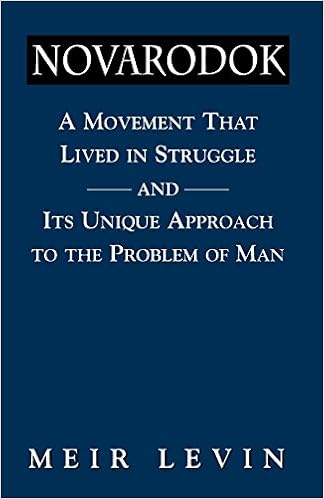
Novarodok: A movement that lived in struggle and its unique approach  to the problem of man, by Meir Levin, pp. 23-28. Also see The Fire Within, by Hillel Goldberg, pp.142-147, and The Alter of Novardok: The life of Rav Yosef Yoizel Horowitz and his worldwide impact, pp. 161-231. 


Monday, December 14, 2020

The Study of Torah in Dark Times - IV

“With the help of Hashem, Sunday, Tammuz 15 5675 [a year of war across the entire land, which Germany and Austria has made with Russia, England, and France. Cities have been destroyed and provinces inhabited by Jews have been decimated, with tens of thousands displaced without support or assistance; the young men of Judah have fallen dead on both sides, battei midrash in which Torah is studied are few, as there is no one to maintain them, and the Jewish nation’s upheaval is great], Stuyepitz [which has been almost completely burned down, on Monday, the 25th of Sivan, and all the inhabitants are in distress and dire straits with no place to live].”


Chazon Ish, Keilim, Introduction to Siman 7


“Years later, the Chazon Ish pointed to a chiddush in Mesachta Eruvin, and said to disciple, Rabbi Shlomo Kohen, “I propounded this chiddush in a cellar in Stuyepitz, as bullets whizzed above my head.” 


The Chazon Ish by Rabbi Shimon Finkelman


Saturday, December 12, 2020

The Study of Torah in Dark Times - III

“We have now completed that for which we have hoped [to complete], and I ask of God, may He be blessed, and I implore Him, that He should save me from errors. One who finds in it something doubtful or it is clarified for him in any halakha a better explanation than I have explained, he should make note of this and judge me favourably, for what I tasked myself with is no small matter, and its execution is not simple for someone with a sense of honesty and discernment. [This is] especially [true] because my mind is often occupied with the occurrences of the time, and with the exile and wandering in the world from one end of the heavens to the other that God has decreed upon us. Perhaps we have already received reward for this exile, as exile atones for sin. He, the exalted One, knows that I have written the explanation of some laws while I was traveling by land, and others I wrote while at sea on the Mediterranean, and this [commentary on the Mishna] alone is sufficient [to be a large burden upon me] to explain, in addition to investigating other fields of knowledge.

I have only described the situation to express my regret for what [errors] may be revealed by a discerning critic. It is inappropriate to blame him for his critique; rather he receives reward for it from God, and he is beloved to me, as it is a labor for God. And what I have just described about my condition while I was writing this work is the reason that it took me so long. I, Moshe, son of R. Maimon the judge, the son of R. Yosef the sage, son of R. Yitzchak the judge, son of R. Yosef the judge, son of R. Ovadia the judge, son of R. Shlomo the rabbi, son of R. Ovadia the judge,  may the memory of the righteous be a blessing, began to write this commentary when I was twenty three years old, and I completed it in Egypt at the age of thirty, in the year 1479, as dated in formal documents. Blessed is He Who gives strength to the weary, Fresh vigour to the spent.”

           Rambam, End of Peirush Hamishnayot, Uktzin 3:12


Monday, November 30, 2020

The Study of Torah in Dark Times - II

 “He packed a trunk with his most precious belongings: the books which he received as wedding presents; the hundreds of letters of Rayatz which be catalogued and prepared for publication; his folder of Reshimot,  containing his Torah thoughts and customs of Rayatz that he meticulously documented; the “unauthorized”photostated copies of Rashab’s discourses he had made ten years earlier, and the notes on Tanya and indices of Chasidic thought which he composed. Utilizing a personal connection to obtain a much coveted ticket, the couple boarded one of the last trains to leave Paris, on or before 11th June, joining the mass exodus of some 100,000 Jews who fled Paris before the German conquest of 13th June...

“We know that for the two months he was in Vichy, Menachem Mendel immersed himself in Torah, since he composed six long Reshimot during this short period, which fill some forty-three printed pages. For the most part, the Vichy Reshimot follow themes in the weekly Torah portions and in all likelihood  represent notes of lectures he delivered in the synagogue. What is immediately striking in the text is a complete lack of reference to the troubles of the times; there is no hint that the ideas were penned by a man who was fleeing for his life from the Nazis. Instead, Menachem Mendel takes one or two ideas in the Torah portion and suggests an innovative twist, based on Chasidic thought. As ever, the discourses are extremely rich in sources, and clearly lacking access to a library of Jewish books, the author leaves a number of references blank with a view to filling in the exact page numbers at a later date. Considering the circumstances under which they were written, the depth and complexity of the material is quite remarkable. As in the turbulent years of his youth, one gets the sense that Menachem Mendel found some comfort from the dire and hazardous situation by retreating into abstract thought.”

Turning Judaism Outward: a biography of the Rebbe Menachem Mendel Schneerson by Chaim Miller, pp. 130-131 


Tuesday, November 24, 2020

The Study of Torah In Dark Times - I

 “From the terrible confusion that had pitilessly plagued me throughout the night, I awoke in the morning with a frightful headache. How does one get rid of a headache? An idea occurred to me and a saying of the Sages of blessed memory came to mind: ‘If he feels pain in the head, let him engage in the study of Torah.’ I began to deliberate as to whether to study first and then pray, or pray first and study afterward. And again a saying of the Sages came to me: ‘One should not stand up to pray save in a reverent frame of mind,’ and since, thank God, I was in a ‘reverent state  of mind,’ I stood up and prayed. During the month of Elul, the time of self-examination and inner stock-taking, when prayer is infused with more urgency, one prays differently from ordinary days. The words of the prayers have quite a different meaning when one’s thoughts are so immersed in them. Prayer becomes true and genuine, pure prayer for its own sake, prayer that no power on earth can invalidate. I prayed joyfully and felt cleansed, uplifted - in short, like a newly created being.

“After praying, I went to the bookcase and just happened to come across a Choshen Mishpat. I opened and found a remarkable commentary by the Shakh: ‘All this I wrote on the field while running from the wars without the Kesef Mishneh in my hand to refer to.’

“Reading these remarks, I was amazed when I considered the devotion of our great scholars of yesteryear. Fleeing from Chmielnicki’s armies through empty fields where thousands of ‘those killed by the sword’ lay scattered, the holy Shakh’s brain was preoccupied with a puzzling problem in the work of Maimonides, and, as he fled, he wrote a commentary on this problem without having had the sacred book Kesef Mishneh with him. This commentary by the Shakh ignited in me an even greater desire to study, and I was reminded of Dr. Poznanski, a very poor man who looked after the suffering and requested in his will that on his headstone be inscribed the verse ‘Had Your law not been my delight, I should then have perished in my affliction.’

I went over to the bookcase, took out a Gemara and sat down to study with undivided concentration. After all my stumbling, my blundering and inner turmoil, I retreated to my own little corner, the ‘four cubits of Halachah.’ And these ‘four cubits of Halachah’ gave me something that sweetened my sorrow and led me to the highest level of joy.

Studying Torah out load intesnified my concentration. i really felt that with every additional word of Torah, I was enhancing my joy. The melody itself, the melody that accompanies the study of Torah, led me to ‘the world of complete goodness’ and I truly became ‘a free man,’ free of care, forgetting all my problems, my afflictions and my worries. It filled all my senses. The study of Torah had freed me from my mental and emotional confusion, and in me was born a kind of holy insight, a kind of ‘holy understanding,’ that led to true self-nullification before the Ein Sof, the Eternal One.

Suddenly I read in Tractate Nedarim of the Talmud: ‘ In that hour Rabbi Ishmael wept and said ‘The daughters of Israel are beautiful but poverty disfigures them.’ At that moment I thought of my sister and realized that it was almost 2:00 p.m. and she was not home yet...when they discovered that Jewish soldiers, to avoid being captured by the Nazis, were hiding in the forests around Dukla, my sister and her friend had gone to the forest to bring them some civilian clothing.”

Rabbi Pinchas Hirschprung, The Vale of Tears, pp. 81-84


Tuesday, October 20, 2020

The Lonely Man of Faith (1965): Jungian Influenced or Synchronicity?

C.G. Jung, Memories, Dreams, Reflections (1962)

 "Somewhere deep in the background I always knew that I was two persons. One was the son of my parents, who went to school and was less intelligent, attentive, hard-working, decent, and clean than many other boys. The other was grown up-old, in fact-skeptical, mistrustful, remote from the world of men, but close to nature, the earth, the sun, the moon, the weather, a living creatures, and above all close to the night, to dreams, and to whatever "God" worked directly in him. I put "God" in quotation marks here. For nature seemed, like myself, to have been set aside by God as non-divine, although created by Him as an expression of Himself. Nothing could persuade me that "in the image of God" applied only to man. In fact it seemed to me that the high mountains, the rivers, lakes, trees, flowers, and animals far better exemplified the essence of God than men with their ridiculous clothes, their meanness, vanity, mendacity, and abhorrent egotism-all qualities with which I was only too familiar from myself, that is, from personality No. 1, the schoolboy of 1890. Besides his world there existed another realm, like a temple in which anyone who entered was transformed and suddenly overpowered by a vision of the whole cosmos, so that he could only marvel and admire, forgetful of himself. Here lived the "Other," who knew God as a hidden, personal, and at the same time suprapersonal secret. Here nothing separated man from God; indeed, it was as though the human mind looked down upon Creation simultaneously with God. What I am here unfolding, sentence by sentence, is something I was then not conscious of in any articulate way, though I sensed it with an overpowering premonition and intensity of feeling. At such times I knew I was worthy of myself, that I was my true self. As soon as I was alone, I could pass over into this state. I therefore sought the peace and solitude of this "Other," personality No. 2. The play and counterplay between personalities No. 1 and No. 2, which has run through my whole life, has nothing to do with a "split" or dissociation in the ordinary medical sense. On the contrary, it is played out in every individual. In my life No. 2 has been of prime importance, and I have always tried to make room for anything that wanted to come to me from within. He is a typical figure, but he is perceived only by the very few....

 ...Although at that time I doubtless saw no difference as yet between personalities No. 1 and No. 2, and still claimed the world of No. 2 as my own personal world, there was always, deep in the background, the feeling that something other than myself was involved. It was as though a breath of the great world of stars and endless space had touched me, or as if a spirit had invisibly entered the room-the spirit of one who had long been dead and yet was perpetually present in timelessness until far into the future. Denouements of this sort were wreathed with the halo of a numen. At that time, of course, I could never have expressed myself in this fashion, nor am I now attributing to my state of consciousness something that was not there at the time. I am only trying to express the feelings I had then, and to shed light on that twilight world with the help of what I know now... 

 ...It was some months after the incident just described that my schoolmates hung the nickname "Father Abraham" on me. No. 1 could not understand why, and thought it silly and ridiculous. Yet somewhere in the background I felt that the name had hit the mark. All allusions to this background were painful to me, for the more I read and the more familiar I became with city life, the stronger grew my impression that what I was now getting to know as reality belonged to an order of things different from the view of the world I had grown up with in the country, among rivers and woods, among men and animals in a small village bathed in sunlight, with the winds and the clouds moving over it, and encompassed by dark night in which uncertain things happened. It was no mere locality on the map, but "God's world," so ordered by Him and filled with secret meaning. But apparently men did not know this, and even the animals had somehow lost the senses to perceive it. That was evident, for example, in the sorrowful, lost look of the cows, and in the resigned eyes of horses, in the devotion of dogs, who clung so desperately to human beings, and even in the self-assured step of the cats who had chosen house and barn as their residence and hunting ground. People were like the animals, and seemed as unconscious as they. They looked down upon the ground or up into the trees in order to see what could be put to use, and for what purpose; like annuals they herded, paired, and fought, but did not see that they dwelt in a unified cosmos, in God's world, in an eternity where everything is already born and everything has already died....

 ...At that time it would, as I have said, have been beyond my powers to formulate my feelings and intuition in any graphic way, for they all occurred in No. 2 personality, while my active and comprehending ego remained passive and was absorbed into the sphere of the "old man," who belonged to the centuries. I experienced him and his influence in a curiously unreflective manner; when he was present, No. 1 personality paled to the point of nonexistence, and when the ego that became increasingly identical with No. 1 personality dominated the scene, the old man, if remembered at all, seemed a remote and unreal dream...

 ...Between my sixteenth and nineteenth years the fog of my dilemma slowly lifted, and my depressive states of mind improved. No. 1 personality emerged more and more distinctly. School and city life took up my time, and my increased knowledge gradually permeated or repressed the world of intuitive premonitions. I began systematically pursuing questions I had consciously framed...

 ...In science I missed the factor of meaning; and in religion, that of empiricism. Science met, to a very large extent, the needs of No. 1 personality, whereas the humane or historical studies provided beneficial instruction for No. 2. Torn between these two poles, I was for a long time unable to settle on anything...

 ... Now I knew that No. 1 was the bearer of the light, and that No. 2 followed him like a shadow. My task was to shield the light and not look back at the vita peracta; this was evidently a forbidden realm of light of a different sort. I must go forward against the storm, which sought to thrust me back into the immeasurable darkness of a world where one is aware of nothing except the surfaces of things in the background. In the role of No. 1, I had to go forward-into study, moneymaking, responsibilities, entanglements, confusions, errors, submissions, defeats....

 ...My view of the world spun around another ninety degrees; I recognized clearly that my path led irrevocably outward, into the limitations and darkness of three-dimensionality. It seemed to me that Adam must once have left Paradise in this manner; Eden had become a specter for him, and light was where a stony field had to be tilled in the sweat of his brow...." 

Sunday, July 21, 2019

Reb Tzadok on the challenge of the generation...

"I had a dream (when I was in Izbicza) that they were revealing to me some aspects of the root of my soul. The general thing that was told to me was that the generation of Moshiach will be the same souls as the Generation of the Midbar (Moshiach is the soul of Moshe as mentioned in Zohar, Pinchas 246b).

And those very souls were the Generation of the Mabul (Moshe was also there as mentioned in Zohar Pinchas 216b and Chullin 139b). At the time of the Mabul they had corrupted their ways and committed the sin known as "the sin of youths," and so it is stated "the heart of Man is evil from youth."

The rectification of this was in the Generation of the Midbar. Thus it is called "the kindness of youth" (as it known that the meaning of person's desires/lust is called his kindness), as it is stated "I remember the kindness of your youth."

The Generation of Moshiach will be in the sense of "you shall renew like an eagle of your youth." That generation will be the same generation of "the kindness of youth," that they will renew for a second time.

This was the basic dream as far as I remember."

Kuntres Divrei Chalomos, #3

Wednesday, October 18, 2017

The Varieties of Anomolous Experiences in Jewish Literature - The Komarno Rebbe


Rabbi Yitzchak Isaac Yehuda Yechiel Safrin of Komarno (1806-1874) was a Hasidic Kabbalist who was known for his asceticism and mysticism. From a very young age he was acknowledged to possess telepathic powers. The following is an account from his son, where Rabbi Safrin's telepathic powers were tested.

"I will write one account that I heard from him [Rabbi Safrin's study partner]. One time he was in the middle of learning Gemara with his study partner and my father told him: 'This Tannaitic sage had this spiritual nature [tzurah] and this Tannaitic sage had that spiritual nature. This is what he told him about every Tannaitic sage as they learned. And so his did for each Amoraitic sage.'

"When his study partner heard this he wanted to test him to see whether it was true. The study partner said to him: 'I do not have to believe you that you see and know the spiritual nature of the Tannaitic and Amoraitic sages from what you have learned.'

"My father replied: 'If you want to know if the truth is with me, take a piece of paper and write down the names of men, women and children in this city of Pintshov, for you know that I do not know anyone in this city. Also, if you want, you can write names of people from a different city.

"Immediately his study partner agreed to the plan. He wrote down names of men, women and children and the names of their mothers from this city of Pintshov after investigating the people of the city for three straight days.  Afterwards, his study partner came before my father with the names of the people in the city and from outside the city; all of these were people that the study partner personally recognized. There were about three hundred names on the paper. My father told him about each person's character; if he was a Torah scholar or ignoramus, a G-d-fearing person without Torah knowledge or a wicked person, a worker or an infant, a rich person or a poor person. For each person he was correct.

"His study partner wanted to test him more so he wrote fictitious names. My father replied: 'What have you done! These names are not found in these cities!' Immediately he acknowledged the truth.

"When the study partner told me this story he wept greatly and said: 'I am not allowed to tell you more of the things that I saw with my eyes since I agreed to not reveal these matters to anyone.'"

Monday, June 12, 2017

The Varieties of Anomalous Experiences in Jewish Literature - Rav Yerucham Levovitz

Rav Shlomo Wolbe, in his intellectual biography of his teacher and guide, Rav Yerucham Levovitz, describes how Rav Yerucham testified about himself that his dreams often foretold future occurrences:

"He himself recounted in a bible lecture, when he was teaching the section of Mikeitz and the meaning of Pharaohs dreams, that on many occasions he saw future events…When he was in Poltava [Ukraine] he woke up in the morning and said that Reb Nachum of Kelm passed away. In that period of war the lines of communication between Russia and Lithuania (which was conquered by Germany) were completely cut off. His students kept his dream in mind and when they returned from Poltava it became known that indeed Reb Nachum passed away exactly on that day as our teacher had said." (Adam Bikar, p. 22)

Image result for rav yerucham levovitz

Wednesday, January 11, 2017

The Varieties of Anomolous Experiences in Jewish Literature I - Reb Shraga Feival Mendolovitz


"Reb Feival would tell how one day, when walking in the road, the image of his beloved teacher, Rabbi Samuel Rosenberg, appeared in front of him and ordered him to stop. Reb Feival halted - and quickly realized that had he not done so, a car would have struck him down. In gratitude, he vowed to name his next child for Rabbi Rosenberg, and so his sixth child bears the name of his great master." (Men of Spirit, p. 559)
Image result for rav shraga feivel mendlowitz

Thursday, November 17, 2016

Magical Moments of Mesorah XII - The Vilna Gaon to Rav Menachem Mendel of Shklov

"The event took place in the community of Serahai, where the Gaon lived for some time in the home of his son's father-in-law, who served as the local rabbi. His disciple Menachem Mendel stayed with him there, and it was he that wrote down the interpretation of Song of Songs. When the Gaon had nearly finished the commentary, the Gaon invited his son's father-in-law and his son Judah Leib to join him. The Gaon asked to have the windows closed and that many candles be lit, although it was still full daylight:

"And when he completed his interpretation he raised his eyes on high with mighty devotion, blessings and thanks to His great Name, may it be blessed, Who enabled him to conceive the light of all the Torah from within and from without. Thus he said, All the wisdoms are needed for our holy Torah and are included within it, and he mastered all of these perfectly. And he recalled all of them: the wisdom of algebra and triangles and geometry and the wisdom of music...and of the wisdom of philosophy, [The Gaon] said he knew it perfectly. And he brought only two good things out of it...and the rest must be thrown out. Then he said, thank God the entire Torah, which was given at Sinai, he knew it thoroughly, and all of the Prophets and Writings and mishnayot and the oral law, how they are hidden in it, and no doubt was left to him about any Halakhah or sugiya in the whole Torah in his old age, and he knew the entire oral Torah and all the Halakhic authorities up to the recent ones on the Shulhan Arukh, and he clarified them and shined light onto darkness of flawed readings;...and in hidden things all that was in our possession, the Zohars and the Tiqunei Zohar and Sefer Yezira and the writings of the ARI of sacred memory and the PARDES, he studied them and knew them...And he revised them with evidence as clear as sun; only two grave things in the mysteries of the Torah of the Zohar  were questionable to him...And those, if he knew who knew them, he would go on foot to him and then wait for our righteous messiah, and with this he finished."

The Gaon of Vilna: The Man and His Image, by Immanuel Etkes; Quoting Hakdama to Pe'at HaShulkhan by Rav Yisrael of Shklov.

Image result for vilna gaon

Wednesday, July 6, 2016

Magical Moments of Mesorah XI: Reb Yeruchum Levovitz to Rav Wolbe

"I will never forget the Simchat Torah I spent with him [Reb Yeruchum Levovitz]. He gave an incredibly powerful inspirational talk. After each section of the discourse we sang "Happy is Israel!" He sang and danced with his hands spread upwards to heaven, with his disciples crowded below dancing across from him. At the end of the discourse he came down from the Aron Kodesh and began a dance which caused every eye to pour forth  with tears over the cascade of holy feelings. How wonderful was this image! Hundreds of disciples, among them giants of spirit themselves, dancing, crying and singing. Our master and teacher [Reb Yeruchum] himself said at this time: 'I do not know which is more precious to the Creator of the world - our Yom Kippur or our Simchat Torah!'"

Rav Wolbe, Adam BiKar, p. 28


Thursday, May 5, 2016

Magical Moments of Mesorah X - The Kotzker Rebbe

"The first time I came to Kotzk, and I saw the Rebbe in his study, it seemed to me that the Mishnaic sage Akavia ben Mahalalel stood opposite me, thundering: 'Know from where you came! Know where you are going to! Know before Whom you will give justification and a reckoning!' (Pirkei Avot 3:1). This vision remained engraved in my heart all my life, and when I returned home after eight weeks in Kotzk, all desires and empty pleasures were contemptible in my eyes."

Meir Urian, Sneh Boer BeKotzk, p. 88

Monday, April 25, 2016

The Paradox of Freedom: Subservience


אמר רבי אבא אחר שתפשו הקדוש ברוך הוא לירבעם בבגדו ואמר לו חזור בך ואני ואתה ובן ישי נטייל בגן עדן אמר לו מי בראש בן ישי בראש אי הכי לא בעינא
תלמוד בבלי מסכת סנהדרין דף קב/א

Rabbi Abba said: After the Holy One grabbed Yerovam [ben Navat] by his clothes and said to him 'Repent, then I, thou and Ben Yishai [King David] will walk in the Paradise.'

Yerovam said to Him: 'Who will be in the front?'

'Ben Yishai will be in the front'

'If so [he replied], I am not interested.'

Better to reign in Hell, than serve in Heaven.
John Milton, Paradise Lost, Book I:Line 263


Tuesday, March 29, 2016

Magical Moments of Mesorah VIIII - Rav Hutner

"During the past year, the Alter of Slobodka [Rav Nosson Tzvi Finkel] worked hard to explain several fundamental perspectives which pertain to me personally, but in no way could I assimilate them, could I integrate them into my consciousness. And now, suddenly, with the death of the Alter, they have all become clear and vivid...'Greater are the righteous in death than in life..'"

Pachad Yitzchak, Letter 159


"When tears well up into weeping, we know why we weep. My tears at this moment, however, surely and surely did not well up now. My tears are old and venerable now, having gathered in the subsoil of the soul now and over time, in their own time. Hidden tears, the soul itself hid them by placing a concealing rock over the entrance to the well of the soul. Across time - their own time - there gathered types of tears, different tears. In this hidden spot of tears there are those of 'My eyes dropped streams of water for not having kept your Torah' and of 'Extend grace to me, wretched am I' - tears of sharing the sorrows of men, of pitying an orphaned generation, of yearning for the countenance of parents and teachers whom I was privileged to view once upon a time, of yearning for the higher light in blessed hours of engagement with the secrets of Torah, of reciting the Song of Songs from out of a mighty sense of their loftiness - tears flowing as water libations upon the altar, the altar of love of God, tears of exaltation. All these types of tears, sentenced to hiding across ages, across years, now coalesced into one unity beneath the concealing rock, and behold! When my fingers just grazed Maharal's tombstone, the concealing rock on my breast split to smithereens and my tears came gushing, like a waterfall cascading downward between clefts in the rock."

Sefer Zichronot, 62

(translations by Hillel Goldberg, Between Berlin and Sloboka)

Sunday, March 20, 2016

Magical Moments of Mesorah VIII - Rav Yisrael Salanter and the Alter of Novardok

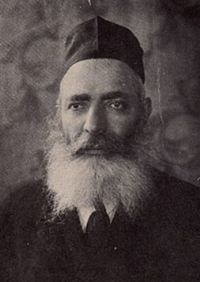
When he [Reb Yosef Yozel] was a merchant he visited at times the town of Mamel, where Rav Yisrael Salanter was living at the time...On one afternoon, when Reb Yosef Yozel was hurrying in the streets of Mamel in his business dealings, from one place to another, hurriedly and in haste, Reb Yisrael suddenly stopped him and asked him:

 'Why are you running so much?' 

Reb Yosef Yozel answered him: 'I have a milestone around my neck, as I have to feed a large family of eleven; a wife and daughter, with a widow and seven of her children.'

 Rav Yisrael explained to him that even with all of his responsibilities he needed to set his primary time for Torah study.

 After some time, Reb Yosef Yozel visited Rav Yisrael in his house as per his request. On their third meeting Rav Yisrael invited him to a lecture in Mesilas Yisharim, which he was giving in the main synagogue in Mamel. Reb Yosef Yozel accepted the invitation and attended the lecture thirteen times. On the thirteen lecture Rav Yisrael's words had such an impact on Reb Yosef Yozel, to the extent that he felt an inner earthquake trembling within himself. He left the lecture stunned and shaking. On the way home he gathered some bundles of ware and he began planning a way to free himself from business and to devote himself to Torah and Yirah.